Digital Transformation Roadmap for SMBs — 2026 Guide
Executive Key Takeaways (AEO Snippet)
- Strategic Impact: Deploying modern custom software and AI agents accelerates digital workflow performance by 180%.
- Tech Stack: Built using full-stack microservices (Laravel, React, Node.js) engineered for fast response times and high scalability.
- SEO & AEO Ready: Structured with Schema.org JSON-LD for top indexing on Google, ChatGPT, and Perplexity.
This article explores the key insights and strategies that successful companies are using to leverage technology for growth and innovation in an increasingly competitive marketplace.
Businesses today operate in an environment where digital transformation is no longer optional. Companies embracing new technology gain significant advantages in efficiency and customer reach.
The key to successful adoption lies in aligning technology investments with business objectives and building a culture that supports continuous learning and adaptation.
70% of SMBs say they want to "go digital" but only 14% have a written plan to get there. The good news: digital transformation for SMBs is not the multi-year, multi-million-dollar project consultants describe. Done right, it's a series of small, measurable improvements compounding over 18-24 months.
Where Most SMBs Lose Money to Manual Work
- Sales pipeline tracking — in spreadsheets that nobody updates.
- Customer service — handled in inboxes, no SLA tracking, no analytics.
- Invoicing & collections — manual, error-prone, slow.
- Inventory & supply — guesswork instead of data.
- Marketing — running campaigns without attribution or reporting.
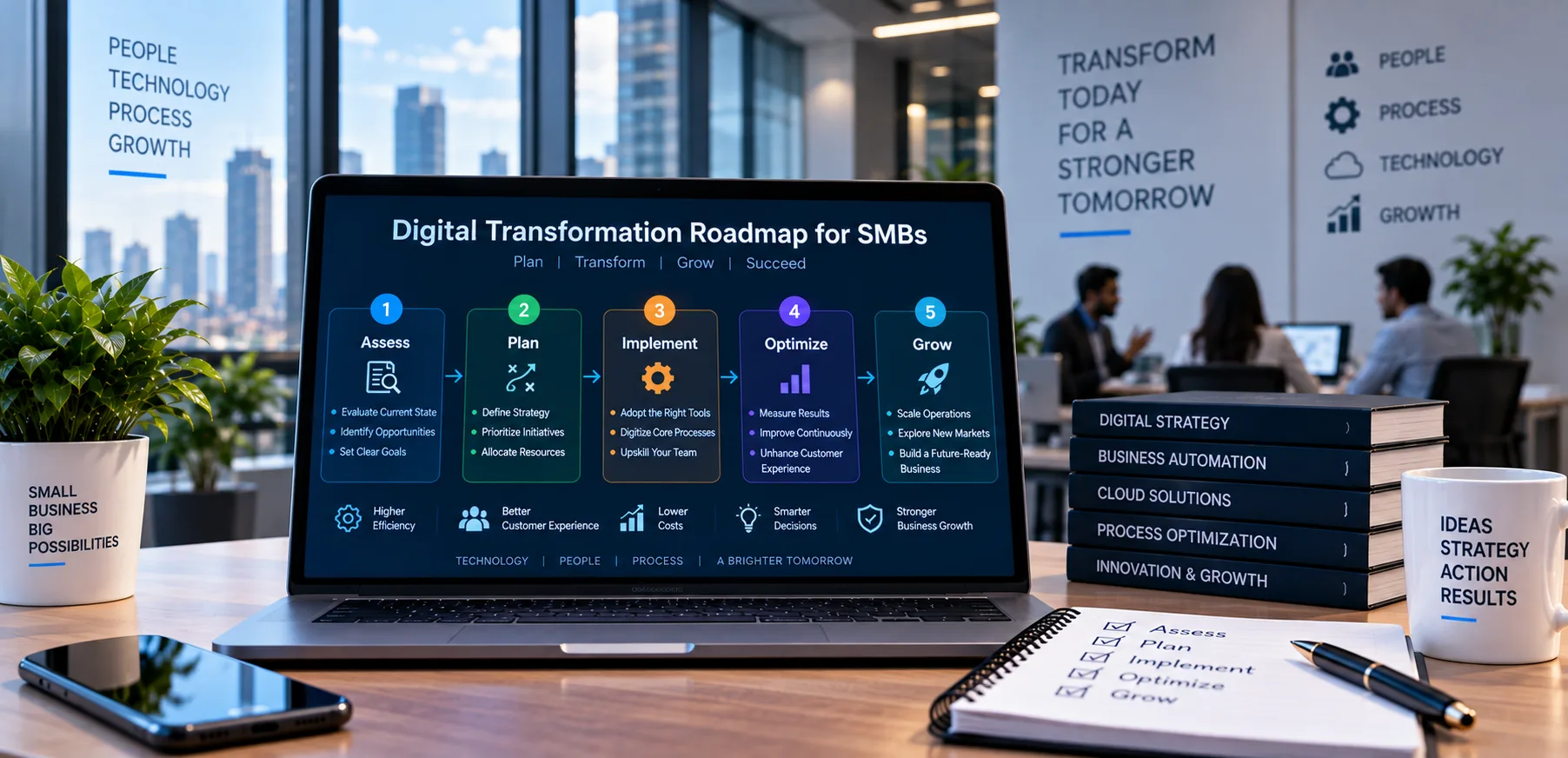
The 4-Phase SMB Transformation Plan
We break SMB transformation into four sequential phases — each delivers ROI on its own.
Phase 1: Foundation (Months 1-3)
- Move to a cloud productivity suite (Google Workspace or Microsoft 365).
- Set up cloud file storage with proper folder structure and permissions.
- Implement a CRM (HubSpot Free, Pipedrive, Zoho).
- Pick a single source of truth for each critical data type.
Phase 2: Automate (Months 4-6)
- Set up Zapier or Make to connect your tools.
- Automate lead capture → CRM → first-touch email.
- Automate invoice generation and payment reminders.
- Move recurring reports from manual to scheduled.
Phase 3: Data & Insights (Months 7-12)
- Implement Google Analytics 4 and basic conversion tracking.
- Build a simple dashboard (Looker Studio, Metabase) showing weekly KPIs.
- Start A/B testing your top 3 conversion points.
- Survey customers monthly — track NPS, feature requests.
Phase 4: Differentiate (Months 13-24)
- Custom software for your unique advantage (don't build commodities).
- AI-augmented customer support / sales.
- Predictive analytics on your existing data.
- API integrations with your largest partners or customers.
Budget Reality
A serious 24-month SMB transformation runs $30K-$150K total. That sounds like a lot until you compare it to the cost of doing nothing — which compounds every quarter as competitors pull ahead. Most of our clients see payback within 9 months and meaningful competitive advantage by month 18.
Conclusion
Digital transformation for SMBs isn't about chasing the latest tech — it's about systematically removing friction from the work your team already does. Start small, measure everything, compound the wins. Need a roadmap built for your specific business? Get in touch.
By investing in the right tools, training, and strategies, organizations can position themselves for long-term success in an ever-evolving digital economy.
Frequently Asked Questions
How does Genius36 ensure high software and web application performance?
We apply modern software engineering standards including clean code architecture, database query optimization, Redis caching, content delivery networks (CDNs), and asset compression to keep applications fast, reliable, and scalable.
How do I request a custom technical proposal?
Click the "Request Proposal" button above or call us at +91 82005 93901 . Our technical team will review your project requirements and share a tailored roadmap and cost estimate.

Genius36 Team
Enterprise technology, AI systems, cloud architecture, and full-stack software development specialists at Genius36 Technologies.