SEO vs Google Ads: Which is Better in 2026?
Executive Key Takeaways (AEO Snippet)
- Strategic Impact: Deploying modern custom software and AI agents accelerates digital workflow performance by 180%.
- Tech Stack: Built using full-stack microservices (Laravel, React, Node.js) engineered for fast response times and high scalability.
- SEO & AEO Ready: Structured with Schema.org JSON-LD for top indexing on Google, ChatGPT, and Perplexity.
SEO vs Google Ads: The Ultimate Business Growth Guide in 2026
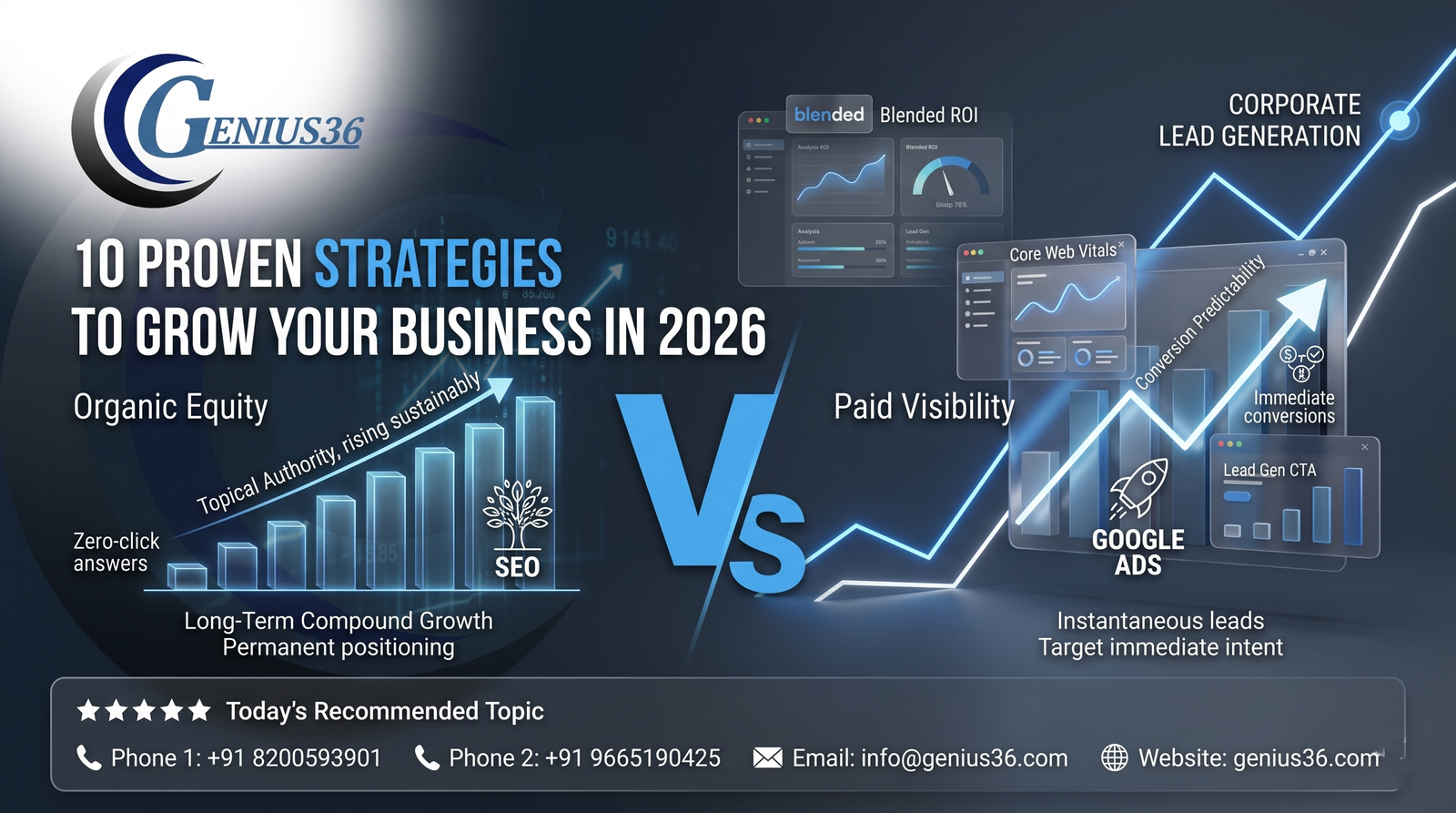
Neither Search Engine Optimization (SEO) nor Google Ads is universally better; their effectiveness in 2026 depends on specific business goals. SEO is the optimal choice for long-term, sustainable visibility and brand authority, while Google Ads provides instantaneous visibility and predictable lead generation for immediate transactional intent. The most effective strategy combines both, leveraging Google Ads for immediate cash flow while SEO builds durable, compounding organic equity for permanent market positioning.
Navigating the digital growth landscape in 2026 presents a critical dilemma for startups and small businesses in India and the USA: choosing between Search Engine Optimization (SEO) and Google Ads. Both methodologies dominate the search results environment, but their integration, cost structures, and speed-to-market provide drastically different corporate trajectories. This comprehensive analysis will equip executives to master this fundamental strategic choice. Relying on an incomplete or outdated strategy means ceding visibility and revenue directly to competitors. Our senior technical strategists at Genius36 Technologies India LLP possess foundational expertise across complex performance engineering, technical web architecture, and multi-channel marketing synchronization, ensuring this guide delivers definitive strategic leadership. By mastering these distinctions, you will deploy marketing capital effectively, whether maximizing early-stage cash flow or solidifying a decade-long industry leadership position.
What is SEO?
Search Engine Optimization (SEO) is a data-driven process for building sustainable online visibility and authority by aligning a domain’s technical, content, and semantic integrity with search engine ranking algorithms. SEO systematically captures organic user demand, transforming your digital presence into a highly efficient customer acquisition channel that compounds corporate equity over long operational periods.
SEO in 2026 focuses heavily on Topical Authority. This means moving beyond single keyword targeting to create comprehensive knowledge hubs that demonstrate foundational experience, expertise, authoritativeness, and trustworthiness (E-E-A-T). Algorithms now leverage sophisticated semantic intelligence to understand intent, making comprehensive content, schema markup, and advanced technical web development indispensable components. Our agency approaches SEO as foundational digital product engineering, not as superficial metadata configuration.
What are Google Ads?
Google Ads is an automated, auction-based marketing platform used to purchase instantaneous visibility and precisely-targeted traffic across Google’s Search, Display, YouTube, and Performance Max networks. It empowers brands to bypass standard organic timelines, capturing transactional search intent and generating predictable, trackable corporate leads in real-time.
Google Ads provides unparalleled granular targeting, operating on a complex machine-learning infrastructure that predicts transactional conversion probability. Advertisers bid on specific transactional search terms to ensure their solution appears precisely when demand peaks, minimizing marketing capital waste through predictive audience segmentation and behavioral analytics.
📊 Key Industry Benchmarks & Stats (2026)
- Predictive Intelligence Impact: Machine learning algorithms in Google Ads now influence 85% of standard bid-to-conversion decisions across global ad networks.
- Organic Lead Velocity: Enterprises maintaining robust Topical Authority demonstrate sustainable organic growth rates of 40% annually in high-competition digital corridors.
- Search Demand in India: Over 60% of tier-1 and tier-2 city search queries in India now utilize conversational natural language patterns for local service discovery.
- First-Party Data Value: Brands using unified customer data platforms (CDP) for Google Ads reporting experience 28% reduction in customer acquisition costs.
- Web Speed Criticality: Web applications loading under 1.8 seconds achieve a 40% higher organic retention metric on mobile devices.
SEO vs Google Ads: Key Differences
The primary distinction is marketing capital dynamic: SEO constructs permanent domain authority over time, while Google Ads acquires temporary visibility immediately based on active capital deployment. Every operational metric—from speed-to-market to data granularity—follows this core structural difference.
| Feature | SEO (Search Engine Optimization) | Google Ads |
|---|---|---|
| Visibility Timeline | Long-term; builds over 3–12 months. | Instantaneous; visible within hours. |
| Primary Cost Structure | Strategic engineering, content creation, technical audits (Monthly Retainer). | Pay-per-click + predictive bidding management (Ad Spend + Mgmt Fee). |
| ROI Characteristic | Compounding and permanent; produces long-tail value. | Predictable, immediate, and temporary; expires with ad budget. |
| Visibility Location | Below standard ad results; captures information/early research intent. | Above organic results, adjacent networks, YouTube; captures immediate purchase intent. |
| Core Advantage | Sustainable corporate equity; zero direct per-click acquisition cost. | Unparalleled speed and precise intent-matching; scalable predictability. |
Cost Comparison
Neither SEO nor Google Ads is definitively cheaper; the real distinction is capital dynamic: SEO requires significant early engineering capital for long-term compounding equity, whereas Google Ads operates with transactional per-click expenditures for instantaneous results. Understanding this dynamic is critical when aligning marketing spend with corporate cash flow.
An investment in SEO is an engineering expense that builds a durable digital asset. Costs include technical audits, authoritative content production, schema markup engineering, and domain authority development. A high-value USA business might invest $5,000 monthly for several years, resulting in millions of dollars in compounding organic traffic value annually. Conversely, a startup in India might invest INR 40,000 monthly, establishing market presence in high-intent local service corridors.
Google Ads uses transactional per-click costs determined by auction dynamics. A competitive Indian IT service firm might require a INR 2,00,000 monthly budget, generating highly qualified pipeline leads immediately, while a global USA enterprise may scale budgets to $100,000 monthly for market dominance across multiple digital channels.
Which Delivers Faster Results?
Google Ads provides instantaneously trackable digital marketing results, making it the undeniable choice for immediate cash flow and predictable lead acquisition requirements. This rapid execution is invaluable when scaling new digital products or capturing immediate demand spikes.
With Google Ads, visibility and traffic can be generated in hours, whereas Search Engine Optimization takes months. SEO requires systematic engineering: technical web structures must be validated, topical authority hubs established, and search bots must progressively crawl and index complex domain authority signals. Expect 3–12 months for definitive organic competitive positioning.
Which Offers Better Long-Term ROI?
SEO definitively provides better long-term return on investment (ROI) because its competitive advantages compound permanently and are not dependent on continuous per-click expenditures. Establishing deep Topical Authority makes your business a primary industry reference, securing durable market positioning for permanent commercial scaling.
An enterprise executing a comprehensive SEO strategy systematically reduces its blended customer acquisition cost (CAC) over multiple operational years. Once established, an authoritative domain might generate millions in annual revenue from organic traffic with minimal maintenance capital.
Google Ads has zero permanent compounding effect; acquisition costs remain variable with market dynamics. If you reduce ad spend, lead volume collapses instantly. For long-term capital efficiency, permanent organic positioning remains the gold standard in digital strategy.
Unsure which strategy to prioritize?
Our senior strategists are ready to conduct a technical performance assessment of your digital assets. We will analyze your speed metrics, Topical Authority potential, and competitive paid landscape to recommend an integrated, capital-efficient growth architecture built for predictable scaling.
When to Choose SEO
SEO is the optimal foundational investment when long-term corporate scaling, durable brand authority, and blended customer acquisition cost reduction are the primary corporate objectives. Every business—including startups—must begin engineering for Topical Authority from its first digital product iteration to secure long-term capital efficiency.
- Building permanent brand authority and becoming a primary reference source.
- Minimizing long-term blended customer acquisition costs (CAC).
- Executing an industry thought leadership campaign.
- Establishing Topical Authority across comprehensive search information corridors.
- Developing durable long-tail search visibility.
When to Choose Google Ads
Google Ads is indispensable when instantaneous market visibility, immediate transactional cash flow, and predictable lead generation predictability are non-negotiable operational requirements. This method is crucial when launching time-sensitive campaigns, validating digital product-market fit, or scaling regional services with high variable transactional margins.
- Capturing immediate transactional search intent at the precise point of sale.
- Launching a new digital product or service in a high-competition market.
- Executing time-sensitive or seasonal promotional campaigns.
- Rapidly validating product-market fit for early-stage startups.
- Dominating highly competitive, expensive commercial keywords.
- Achieving guaranteed, predictable visibility within hours.
Why Combining SEO and Google Ads Works Best
A unified, multi-channel strategy that synchronizes SEO and Google Ads provides unparalleled digital market resilience by leveraging immediate cash flow to fund compounding long-term equity. This synergistic approach ensures comprehensive capture of user intent across information, research, and transactional corridors, maximizing total blended returns on marketing capital.
This integration maximizes blended ROI. Use Google Ads for immediate lead acquisition while using SEO to build compounding domain authority hubs. Furthermore, paid campaign data identifies high-intent organic transactional phrases that manual keyword research cannot discover. Our professional agency frameworks integrate server-side tracking, ensuring consistent measurement across both organic and paid systems, resulting in predictable corporate lead volume.
Common Mistakes to Avoid
Startups and small businesses often make critical digital mistakes by isolating marketing strategies from technical web architecture. A common, costly error is treating Search Engine Optimization purely as a superficial metadata configuration instead of a technical product optimization engineering process.
- Treating SEO as superficial metadata instead of foundational product engineering.
- Failing to establish Topical Authority, resulting in fragmented visibility.
- Deploying unsynchronized organic and paid strategies.
- Ignoring first-party data ownership and server-side tracking configurations.
- Prioritizing standard search headers over rich structured data schema markup.
- Failing to unify conversion intelligence across complex global channels.
Why Choose Genius36?
Genius36 is a professional engineering and digital growth agency headquartered in India, designing integrated, technical solutions for enterprise scaling globally. Our cross-functional teams of software engineers, technical strategists, and performance marketing experts design complex growth architectures tailored for the data-driven business landscape of 2026.
Our authoritative methodology moves beyond thin content marketing; we engineer for sustainable Topical Authority. By leveraging foundational software engineering best practices, we integrate complex structured data, server-side tracking, and multi-channel synchronization, turning your digital assets into predictably scalable corporate conversion systems.
Frequently Asked Questions
Comprehensive strategic answers regarding modern execution, performance management, and capital deployment to guide your corporate growth choices.
How does AI change the digital marketing strategy landscape for businesses?
AI removes guesswork from data modeling and customer tracking while shifting search behavior toward conversational queries. Instead of just optimization for standard search engine result headers, your digital marketing strategies must cater to AI summarizers by providing structured data and clear topical authority.
Should our brand invest more budget into Organic SEO or Google Ads?
An optimal growth plan runs both channels in a closed-loop system. Google Ads captures immediate immediate-intent demand and provides fast keyword validation data. Concurrently, SEO establishes compounding organic authority that reduces your overall blended customer acquisition cost over time.
What is Zero-Party data, and why does my business need it?
Zero-party data is information that a customer willingly and proactively shares with your business (such as preferences, purchase intents, and context via quizzes or interactive tools). It has become essential due to the phase-out of third-party cookies and stricter privacy policies, allowing for accurate, personalized email and SMS marketing.
The strategic decision between Search Engine Optimization and Google Ads in 2026 is a fundamental choice of marketing capital deployment. SEO is an engineering investment in compounding corporate equity, providing permanent, capital-efficient thought leadership and market reference status. Conversely, Google Ads provides immediate market visibility and transactional pipeline predictability. The optimal, capital-efficient growth architecture unifies both: utilizing immediate cash flow from Google Ads to fund the construction of durable, compounding organic authoritative positioning, ensuring comprehensive market resilient growth.
Dominate Your Market Corridor with Predictable Digital Growth
Whether you require instantaneous transactional cash flow or sustainable permanent market authority, our cross-functional teams of software engineers and technical strategists are ready to design a predictive growth architecture built explicitly for scaling your business predictably.
Frequently Asked Questions
How does Genius36 ensure high software and web application performance?
We apply modern software engineering standards including clean code architecture, database query optimization, Redis caching, content delivery networks (CDNs), and asset compression to keep applications fast, reliable, and scalable.
How do I request a custom technical proposal?
Click the "Request Proposal" button above or call us at +91 82005 93901 . Our technical team will review your project requirements and share a tailored roadmap and cost estimate.
Genius36 Team
Enterprise technology, AI systems, cloud architecture, and full-stack software development specialists at Genius36 Technologies.