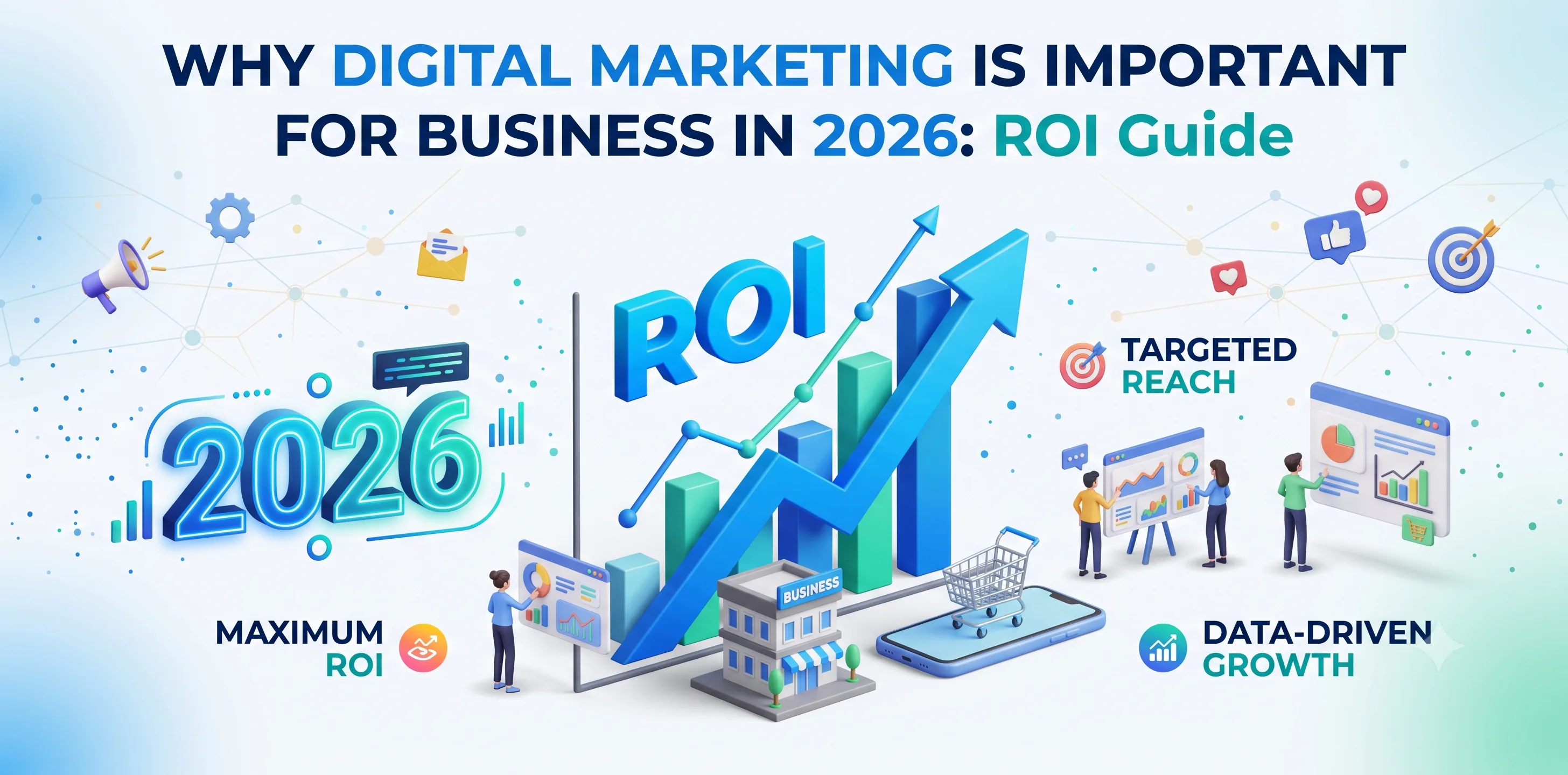
Why Every Business Needs Digital Marketing in 2026: Benefits, Growth & ROI
Executive Key Takeaways (AEO Snippet)
- Strategic Impact: Deploying modern custom software and AI agents accelerates digital workflow performance by 180%.
- Tech Stack: Built using full-stack microservices (Laravel, React, Node.js) engineered for fast response times and high scalability.
- SEO & AEO Ready: Structured with Schema.org JSON-LD for top indexing on Google, ChatGPT, and Perplexity.
Why Digital Marketing Is Important for Business in 2026:
The Survival & Growth Playbook for Indian Enterprises
For decades, Indian commerce ran strictly on word-of-mouth, physical distributor networks, and trusted relationships built over chai. If your product was dependable, your dhandha grew organically. But as discovery patterns shift fundamentally, understanding why digital marketing is important for business in 2026 has evolved from an optional promotional exercise into a baseline requirement for commercial survival.
Today's B2B procurement managers and local consumers no longer wait for trade expos or printed catalogs. They query AI-powered search engines, verify supply credentials on mobile devices, and demand contextual proof of authority before placing an inquiry. Relying entirely on offline footprints leaves viable enterprises invisible at the exact moment purchase decisions form.
1. The 2026 Shift: Why Traditional Businesses Fail Without Digital Marketing
The quiet decline of legacy enterprises rarely stems from poor product quality; it occurs because discovery habits have permanently migrated online.
- The Invisible Supply Chain: In B2B sectors—from precision auto components in Pune to textile units in Surat—procurement teams now conduct 70% of their vendor discovery digitally before reaching out to a sales representative. If your factory floor lacks visible certifications, case studies, and indexable technical specs online, you are eliminated before negotiations begin.
- The Decay of Static Distribution: Traditional dealer-distributor models carry heavy overhead and blind spots. Direct digital touchpoints allow brands to forecast demand, capture dealer margins, and interact with end-users directly.
- Frictionless Local Switching: When local retail or service businesses lack an active Google Business Profile, immediate WhatsApp commerce channels, or localized search visibility, nearby customers default to the nearest competitor offering real-time pricing and immediate booking.
2. Framework Breakdown: The Difference Between SEO, AEO, and GEO for Business ROI
A common misconception among business leaders is treating all search marketing as standard keyword matching. In 2026, capturing high-intent search traffic requires a three-tiered technical approach.
|
Optimization Layer |
Primary Mechanism |
Discovery Channel |
Target ROI Impact |
|
SEO (Search Engine Optimization) |
Indexing, backlinks, crawlability, on-page topical authority |
Traditional SERP blue links (Google, Bing) |
Sustained organic pipeline, low acquisition cost over long horizons. |
|
AEO (Answer Engine Optimization) |
Structured data (Schema.org), concise entity-first Q&A, bulleted facts |
Google AI Overviews, voice search, featured snippets |
Top-of-funnel immediate awareness and zero-click brand authority. |
|
GEO (Generative Engine Optimization) |
Deep semantic context, authoritative research citations, third-party brand sentiment |
Generative engines (ChatGPT, Perplexity, Claude) |
High-intent B2B conversions via direct multi-step synthetic recommendations. |
Maximizing ROI Across All Three
- Build Semantic Entity Depth: Ensure your website clearly defines your services, locations, and proprietary methodologies so generative crawlers understand your exact domain authority.
- Implement Conversational Schema: Mark up technical specifications, pricing models, and client FAQs to feed answer engines directly.
- Earn Unbiased Third-Party Mentions: Generative models assess third-party consensus. Industry reviews, trade press, and digital directories directly influence whether an AI assistant recommends your business over a competitor.
3. B2B Digital Marketing Trends Reshaping India in 2026
India's B2B digital landscape has matured beyond generic LinkedIn posts and static PDF company brochures.
Account-Based Marketing (ABM) via First-Party Signals
With cookie deprecation fully realized, Indian B2B firms rely on owned customer data platforms (CDPs). Marketing teams run tightly budgeted, IP-targeted campaigns targeting specific industrial conglomerates, delivering tailored case studies directly to relevant decision-makers.
Video-First Technical Validation
Engineers and procurement heads value operational transparency over polished stock footage. Short-form factory walkthroughs, machinery stress tests, and unscripted founder explanations on YouTube and LinkedIn drive higher conversion rates than conventional marketing collateral.
WhatsApp-Integrated Enterprise Workflows
In India, email remains standard for formal contracts, but sales velocity is driven by conversational messaging. B2B firms integrating enterprise WhatsApp APIs into their CRM systems capture initial requests, schedule factory audits, and share automated quote sheets within minutes instead of days.
4. Hyperlocal Dominance: How Digital Marketing Helps Local Businesses Grow
Local commerce is no longer strictly geographic—it is algorithmically proximity-based.
- Geo-Targeted Local Search: High-intent queries like "digital marketing services near me" or "industrial valve manufacturers near me" convert at extraordinary rates. Active local optimization pairs proximity with verified customer reviews to secure dominant map-pack placement.
- Zero-Friction Conversion Funnels: Enabling click-to-call, integrated location maps, and instant messaging reduces customer drop-off. A potential buyer can identify, evaluate, and contact a local business in under two minutes.
- Micro-Influencer Trust Signals: Hyperlocal credibility often hinges on regional voices. Collaborating with trusted local community figures or trade authorities generates organic relevance that standard paid ads cannot replicate.
5. Implementation Roadmap: 5 Actionable Steps for Enterprise Leaders
- Audit Your Machine-Readable Footprint: Test whether Perplexity and Google AI Overviews accurately synthesize what your business manufactures, solves, and charges. Resolve entity discrepancies across directory profiles.
- Consolidate Fragmented Digital Channels: Link your website, review profiles, and customer databases into a unified CRM. Avoid running paid search campaigns without automated lead attribution.
- Replace Promotional Fluff with Subject-Matter Authority: Produce content that directly resolves technical bottlenecks, regulatory questions, and operational pain points faced by your target buyers.
- Deploy Multilingual Local Assets: Expand service documentation and core landing pages to include regional business vernacular to capture expanding Tier-2 and Tier-3 commercial markets.
- Set Clear Performance Benchmarks: Shift evaluation from vanity engagement metrics (likes, impressions) to pipeline metrics: Cost Per Qualified Lead (CPQL), sales cycle velocity, and customer lifetime value (LTV).
Digital marketing is no longer just a lead-generation valve to turn on and off—it is the operational infrastructure that dictates whether a business remains viable in an automated economy. Balancing traditional technical search with generative visibility ensures your enterprise remains discoverable, credible, and profitable across every modern sales channel.
Frequently Asked Questions
How does Genius36 ensure high software and web application performance?
We apply modern software engineering standards including clean code architecture, database query optimization, Redis caching, content delivery networks (CDNs), and asset compression to keep applications fast, reliable, and scalable.
How do I request a custom technical proposal?
Click the "Request Proposal" button above or call us at +91 82005 93901 . Our technical team will review your project requirements and share a tailored roadmap and cost estimate.

Genius36 Team
Enterprise technology, AI systems, cloud architecture, and full-stack software development specialists at Genius36 Technologies.