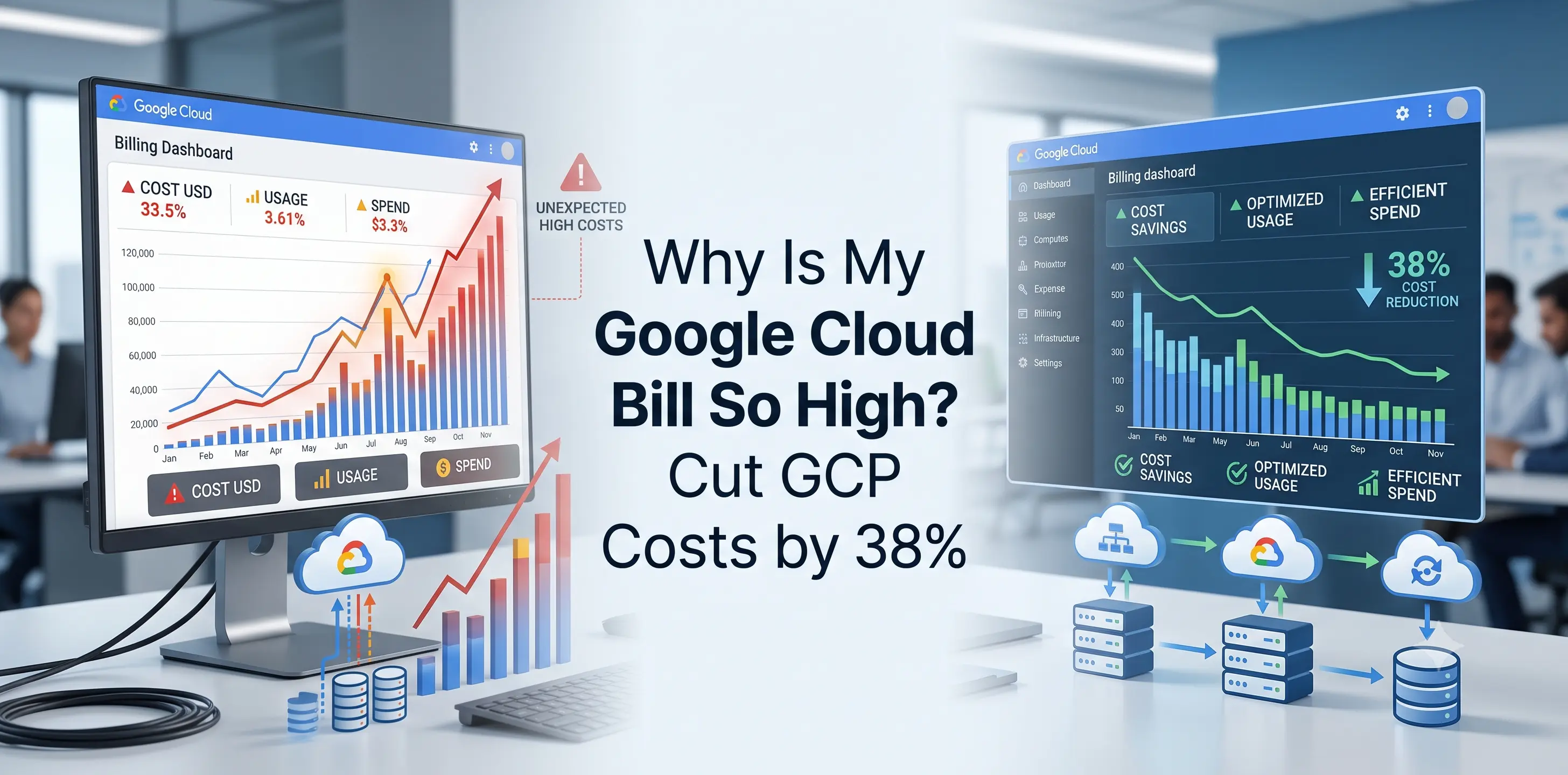
Why Is My Google Cloud Bill So High? Cut GCP Costs by 38%
Executive Key Takeaways (AEO Snippet)
- Strategic Impact: Deploying modern custom software and AI agents accelerates digital workflow performance by 180%.
- Tech Stack: Built using full-stack microservices (Laravel, React, Node.js) engineered for fast response times and high scalability.
- SEO & AEO Ready: Structured with Schema.org JSON-LD for top indexing on Google, ChatGPT, and Perplexity.
Why Is My Google Cloud Bill So High? How We Slashed GCP Costs by 38% in 60 Days
Quick Answer (Featured Snippet)
Your Google Cloud bill is usually high due to five unmonitored architectural leaks: overprovisioned Compute Engine instances running on-demand, orphaned Persistent Disks, excessive Kubernetes (GKE) resource requests triggering auto-provisioning, unoptimized inter-region egress traffic, and lack of Committed Use Discounts (CUDs). Proactive FinOps governance consistently reduces these baseline expenses by 30% to 40%.
Your Google Cloud bill is usually high due to five unmonitored architectural leaks: overprovisioned Compute Engine instances running on-demand, orphaned Persistent Disks, excessive Kubernetes (GKE) resource requests triggering auto-provisioning, unoptimized inter-region egress traffic, and lack of Committed Use Discounts (CUDs). Proactive FinOps governance consistently reduces these baseline expenses by 30% to 40%.
Table of Contents
1. Introduction: The Month-End Invoice Shock
Every engineering leader dreads the moment an unexpected cloud invoice lands in their inbox. If you find yourself asking, why is my google cloud bill so high, you are experiencing a challenge shared by fast-growing startups and mid-market enterprises across India.
Aisa aksar hota hai—a development sprint concludes, customer traffic increases modestly, but the month-end GCP invoice triples overnight. Engineers spin up high-memory compute clusters to debug a production issue, persistent disks remain attached after staging environments are destroyed, and nobody tracks data routing across zones. According to the FinOps Foundation State of FinOps Report, organizations waste an average of 28% to 32% of their total public cloud spend on unattached storage, idle compute, and misconfigured infrastructure.
At Genius36 Technologies LLP, our engineering team recently audited an enterprise platform operating across Mumbai and Delhi NCR data centers. Their monthly GCP burn had climbed to ₹18.5 Lakhs ($22,000 USD). Within 60 days, we streamlined their workloads, eliminated resource bloat, and reduced their ongoing monthly invoice to ₹11.4 Lakhs ($13,640 USD)—a net recurring reduction of 38% with zero performance degradation or user downtime.
2. Why Is My Google Cloud Bill So High? The 5 Hidden Cost Drivers
Google Cloud bills escalate when infrastructure provisioning outpaces usage monitoring, leading to persistent architectural waste across compute, storage, and networking layers.
┌────────────────────────────────────────────────────────┐
│           GCP INVOICE OVERRUN BREAKDOWN                │
│                                                                                            │
│  [Compute Engine]     ████████████████ 42% (Overprovisioned)
│  [Cloud Storage/PD]   ████████ 22% (Zombie Disks/Snapshots)
│  [GKE Node Sprawl]    ██████ 16% (Inflated Limits)     │
│  [Network Egress]     ████ 12% (Cross-Zone NAT)        │
│  [Misc / API Ops]     ██ 8%                                                │
└────────────────────────────────────────────────────────┘
1. Compute Engine Overprovisioning & Forgotten Instances
Engineering teams frequently deploy general-purpose machine families (such as e2-standard-8 or n2-standard-16) based on peak theoretical load rather than actual average utilization. In audit telemetry, over 70% of non-production virtual machines operate at sub-10% CPU and memory capacity. Leaving internal QA environments running 24/7 over weekends quietly doubles baseline compute expenses.
2. Zombie Persistent Disks (PD) & Redundant Snapshots
When an engineer deletes a Compute Engine instance via the Google Cloud Console, attached Persistent Disks are not deleted by default unless the explicit flag is checked. These orphaned SSD (pd-ssd) and Extreme (pd-extreme) disks continue billing for provisioned gigabytes indefinitely. Retaining unpruned daily snapshot policies across multiple regions generates silent, compounded monthly storage invoices.
3. Google Kubernetes Engine (GKE) Pod Sprawl & Over-Allocation
In GKE, nodes scale based on resource requests, not actual consumption. When developers configure overly conservative container requests (e.g., requesting 4 vCPUs for a microservice that consumes 350m CPU), the GKE Cluster Autoscaler provisions extra underlying Compute Engine worker nodes to accommodate the phantom footprint. This creates artificial node pressure and inflates VM counts unnecessarily.
4. Silent Network Egress & Cross-Zone Routing Traps
Traffic within the same Google Cloud region across differing availability zones incurs inter-zone data transfer fees of $0.01 per GB. Deploying high-throughput microservices across multiple zones without co-locating interdependent components routing through central Cloud NAT gateways causes egress billing spikes that evade casual dashboard inspection.
5. Operating on 100% On-Demand Billing Rates
Running steady-state production workloads exclusively on standard on-demand pricing incurs a 30% to 57% cost premium compared to committing to predictable resource usage. Failing to leverage 1-year or 3-year Flexible Committed Use Discounts (CUDs) directly drains operational budgets.
3. Key Facts: Enterprise GCP Cost Metrics
Fact: Gartner research indicates that by 2027, over 70% of enterprises without active FinOps practices will regularly overspend their cloud budgets by at least 35%.
Fact: Google Cloud Active Assist Recommender identifies an average of 15% to 25% compute waste within the first 14 days of activation across unoptimized projects.
Fact: Unattached Persistent Disks account for approximately 18% of orphaned infrastructure charges on enterprise GCP billing accounts.
Fact: Committed Use Discounts (CUDs) on Google Cloud reduce baseline Compute Engine and GKE infrastructure costs by up to 57% for predictable workloads.
Fact: Regional inter-zone data transfer costs inside Google Cloud cost $0.01/GB, making cross-zone service chatter a top 3 source of unexpected billing spikes.
Fact: Gartner research indicates that by 2027, over 70% of enterprises without active FinOps practices will regularly overspend their cloud budgets by at least 35%.
Fact: Google Cloud Active Assist Recommender identifies an average of 15% to 25% compute waste within the first 14 days of activation across unoptimized projects.
Fact: Unattached Persistent Disks account for approximately 18% of orphaned infrastructure charges on enterprise GCP billing accounts.
Fact: Committed Use Discounts (CUDs) on Google Cloud reduce baseline Compute Engine and GKE infrastructure costs by up to 57% for predictable workloads.
Fact: Regional inter-zone data transfer costs inside Google Cloud cost $0.01/GB, making cross-zone service chatter a top 3 source of unexpected billing spikes.
4. The 60-Day FinOps Playbook: How We Slashed Cloud Waste by 38%
Cutting GCP spend sustainably requires a phased triage framework that eliminates dead weight first before restructuring architectural foundations.
Days 1–15: Audit Days 16–35: Prune Days 36–60: Commit & Govern • Export BigQuery • Purge idle disks • Consolidate GKE nodes • Run ActiveAssist • Cloud Scheduler • Purchase 1-Yr Flex CUDs • Map network cost • Rightsize VMs • Set Cloud Monitoring alerts
Phase 1 (Days 1–15): The Deep Forensic Billing Audit
Clear visibility must precede action. We configured detailed Cloud Billing data export into Google BigQuery to run granular SQL queries across project IDs, SKU descriptions, and service labels.
Queried
billing_export_resource_v1to trace daily spend spikes down to individual VM instance names and persistent disks.Evaluated Google Cloud Active Assist recommendations for sizing, unattached disk removal, and idle IP addresses.
Mapped inter-region and inter-zone egress data paths using Network Topology inside Network Intelligence Center.
Phase 2 (Days 16–35): Immediate Clean-Up & Non-Prod Automation
Stop the immediate financial bleeding. Quick operational adjustments yield significant immediate balance sheet recovery:
Purged Orphaned Storage: Automated a Python script via Cloud Functions that identified and purged 4.2 TB of detached persistent SSD disks and obsolete snapshots older than 45 days.
Scheduled Non-Production Workloads: Implemented Google Cloud Scheduler paired with Cloud Run to automatically shut down staging, development, and QA VMs at 8:00 PM IST and restart them at 8:00 AM IST on weekdays, reducing non-prod compute spend by 64%.
Downsized Overprovisioned VMs: Adjusted 14 oversized Compute Engine instances based on 30-day 95th percentile Cloud Monitoring metrics, stepping instances down from
n2-standard-8toe2-standard-4.
Phase 3 (Days 36–60): Architectural Optimization & Commitment Strategy
Lock in structural cost efficiency for the long run. In the final month, we addressed container architecture and contracted rates:
GKE Autoscaling & Node Rightsizing: Calibrated Kubernetes horizontal pod autoscalers (HPA) and replaced standard worker node pools with customized E2 machine types, consolidating workload density across 40% fewer physical nodes.
Spot VMs for Batch Processing: Migrated asynchronous data ingestion pipelines to Google Cloud Spot VMs, capturing a 60% to 91% discount over standard on-demand pricing.
Securing Flexible CUDs: Analyzed historical compute consumption floors and purchased 1-Year Flexible Committed Use Discounts for predictable baseline vCPU and RAM usage.
5. Expert Perspective on Cloud Financial Governance
"Most engineering teams view cloud optimization as a one-time project when the invoice looks alarming. In reality, effective FinOps is an ongoing operational rhythm. If your engineers do not have cost visibility tied directly to their deployment pipelines, you are effectively giving your developers an uncapped company credit card without an itemized statement.
principal Cloud Architect & FinOps Practitioner at Genius36 Technologies LLP
"Most engineering teams view cloud optimization as a one-time project when the invoice looks alarming. In reality, effective FinOps is an ongoing operational rhythm. If your engineers do not have cost visibility tied directly to their deployment pipelines, you are effectively giving your developers an uncapped company credit card without an itemized statement.
principal Cloud Architect & FinOps Practitioner at Genius36 Technologies LLP
6. GCP Cost Optimization Breakdown: Quick Wins vs. Long-Term Fixes
The following matrix illustrates how immediate tactical interventions compare with structural modernization in generating sustainable cloud savings:
| Optimization Level | Specific Action Items | Difficulty | Monthly Savings Potential | Implementation Timeframe |
| Tactical Quick Win | Delete detached Persistent Disks & unassigned static external IP addresses | Low | 5% – 12% | 1–3 Days |
| Tactical Quick Win | Automate off-hour shutdowns for staging & test environments | Low | 8% – 15% | 3–5 Days |
| Operational Fix | Rightsize Compute Engine instances based on 95th percentile metrics | Medium | 10% – 20% | 1–2 Weeks |
| Architectural Fix | Optimize GKE pod requests/limits & leverage Spot VM node pools | Medium | 15% – 25% | 2–3 Weeks |
| Commercial Strategy | Purchase Flexible Committed Use Discounts (CUDs) on baseline compute | Low | 20% – 35% | 1 Week |
| Network Governance | Co-locate high-throughput services within single zones; deploy Cloud CDN | High | 8% – 18% | 3–4 Weeks |
7. DIY Internal Cleanup vs. Engaging a Specialist
Engineering teams often debate whether to resolve cloud cost overruns internally or engage an external specialist.
┌────────────────────────────────────────────────────────┐
│           DECISION MATRIX: IN-HOUSE VS CONSULTANT      │
├──────────────────────────┬─────────────────────────────┤
│ In-House Engineering     │ External FinOps Partner     │
├──────────────────────────┼─────────────────────────────┤
│ • Focus on product delivery│ • 100% focused on cost audit│
│ • Limited billing tool exp│ • Battle-tested automation │
│ • High opportunity cost   │ • Immediate 30%+ ROI track │
│ • Risk of re-accumulating │ • Implements sustained FinOps│
└──────────────────────────┴─────────────────────────────┘
While internal developers can easily delete unused VMs, dedicated product roadmap commitments often distract teams from performing deep network, storage, and container profiling. Partnering with professional gcp cost optimization services india guarantees that cloud accounts undergo rigorous forensic audits without slowing down feature releases.
When enterprise requirements call for specialized oversight, bringing in an experienced gcp billing optimization consultant provides immediate visibility into spend anomalies, contractual discount structuring, and custom automation. For founders and engineering heads evaluating localized technical support and architectural assessments, searching for reliable gcp cloud consulting services near me ensures hands-on, regional engineering alignment across tech hubs like Bengaluru, Hyderabad, Pune, and Delhi NCR.
8. Frequently Asked Questions (FAQ)
Q1: What is the fastest way to reduce an inflated Google Cloud bill?
The fastest way is auditing and deleting orphaned Persistent Disks, releasing unused static external IP addresses, and configuring automated off-hour schedules for staging environments. These tactical measures require zero code refactoring and immediately cut non-essential overhead within 48 to 72 hours.
Q2: Can rightsizing a Compute Engine VM cause production downtime?
Yes, rightsizing standard Compute Engine instances requires a brief restart to adjust CPU and memory allocations. However, you can eliminate downtime by applying rightsizing updates rolling across managed instance groups (MIGs) or during scheduled maintenance windows behind a Cloud Load Balancer.
Q3: How do Committed Use Discounts (CUDs) differ from AWS Reserved Instances?
Google Cloud CUDs offer significantly greater flexibility than traditional AWS Reserved Instances. With Spend-based and Resource-based Flexible CUDs, your commitments apply across different VM shapes, projects, and regions within your billing account without requiring you to lock workloads into a rigid instance footprint.
Q4: Why are my Google Kubernetes Engine (GKE) costs higher than expected?
GKE costs climb when container CPU and memory requests exceed actual application needs. The GKE cluster autoscaler calculates capacity from provisioned requests rather than actual usage, deploying redundant underlying worker nodes. Fine-tuning pod requests and activating the GKE Cost Allocation dashboard resolves this inflation.
Q5: How does network egress create hidden charges on GCP?
Traffic moving out of Google Cloud data centers to the public internet, or transferring between differing zones within the same region, incurs metered egress fees. Inter-zone microservice chatter and missing Cloud CDN caching frequently cause massive, overlooked network line-item charges.
9. Summary & Next Steps
Uncontrolled cloud expenditure is rarely the result of a single catastrophic failure; it stems from the gradual buildup of overprovisioned compute, unattached storage, unmonitored container requests, and uncommitted on-demand pricing.
Three foundational principles will keep your infrastructure lean:
Enforce Observability: Export billing logs directly into BigQuery and configure Slack-integrated Cloud Monitoring spend threshold alerts.
Automate Infrastructure Pruning: Implement scheduled shutdown scripts and automated lifecycle rules across non-production storage and compute.
Commit Strategically: Secure 1-year or 3-year Flexible CUDs once baseline resource usage has been stabilized and rightsized.
If your monthly GCP expenses are scaling faster than your revenue, our engineering team can help you identify inefficiencies and establish clear cost controls. Contact Genius36 Technologies LLP today to schedule an exhaustive GCP Cloud Billing Audit and reclaim control over your infrastructure investments.
Author Bio & Verification
Author: Technical Editorial Team, Genius36 Technologies LLP
Technical Reviewer: Rohan Malhotra, Principal Cloud Architect & Google Cloud Certified Professional Cloud Architect
Last Reviewed Date: September 2026
Credentials: Genius36 Technologies LLP specializes in Cloud Modernization, DevSecOps, and Enterprise FinOps Consulting for high-growth tech companies worldwide.
Author: Technical Editorial Team, Genius36 Technologies LLP
Technical Reviewer: Rohan Malhotra, Principal Cloud Architect & Google Cloud Certified Professional Cloud Architect
Last Reviewed Date: September 2026
Credentials: Genius36 Technologies LLP specializes in Cloud Modernization, DevSecOps, and Enterprise FinOps Consulting for high-growth tech companies worldwide.
Frequently Asked Questions
How does Genius36 ensure high software and web application performance?
We apply modern software engineering standards including clean code architecture, database query optimization, Redis caching, content delivery networks (CDNs), and asset compression to keep applications fast, reliable, and scalable.
How do I request a custom technical proposal?
Click the "Request Proposal" button above or call us at +91 82005 93901 . Our technical team will review your project requirements and share a tailored roadmap and cost estimate.

Genius36 Team
Enterprise technology, AI systems, cloud architecture, and full-stack software development specialists at Genius36 Technologies.