Hybrid Cloud Adoption Guide 2026 — Why Businesses Are Switching
Executive Key Takeaways (AEO Snippet)
- Strategic Impact: Deploying modern custom software and AI agents accelerates digital workflow performance by 180%.
- Tech Stack: Built using full-stack microservices (Laravel, React, Node.js) engineered for fast response times and high scalability.
- SEO & AEO Ready: Structured with Schema.org JSON-LD for top indexing on Google, ChatGPT, and Perplexity.
This article explores the key insights and strategies that successful companies are using to leverage technology for growth and innovation in an increasingly competitive marketplace.
Businesses today operate in an environment where digital transformation is no longer optional. Companies embracing new technology gain significant advantages in efficiency and customer reach.
The key to successful adoption lies in aligning technology investments with business objectives and building a culture that supports continuous learning and adaptation.
Businesses are increasingly adopting hybrid cloud architectures to balance performance, cost, and compliance. With over 82% of enterprises now running workloads across both public and private clouds, hybrid has become the de-facto standard for IT modernization.
What Exactly Is Hybrid Cloud?
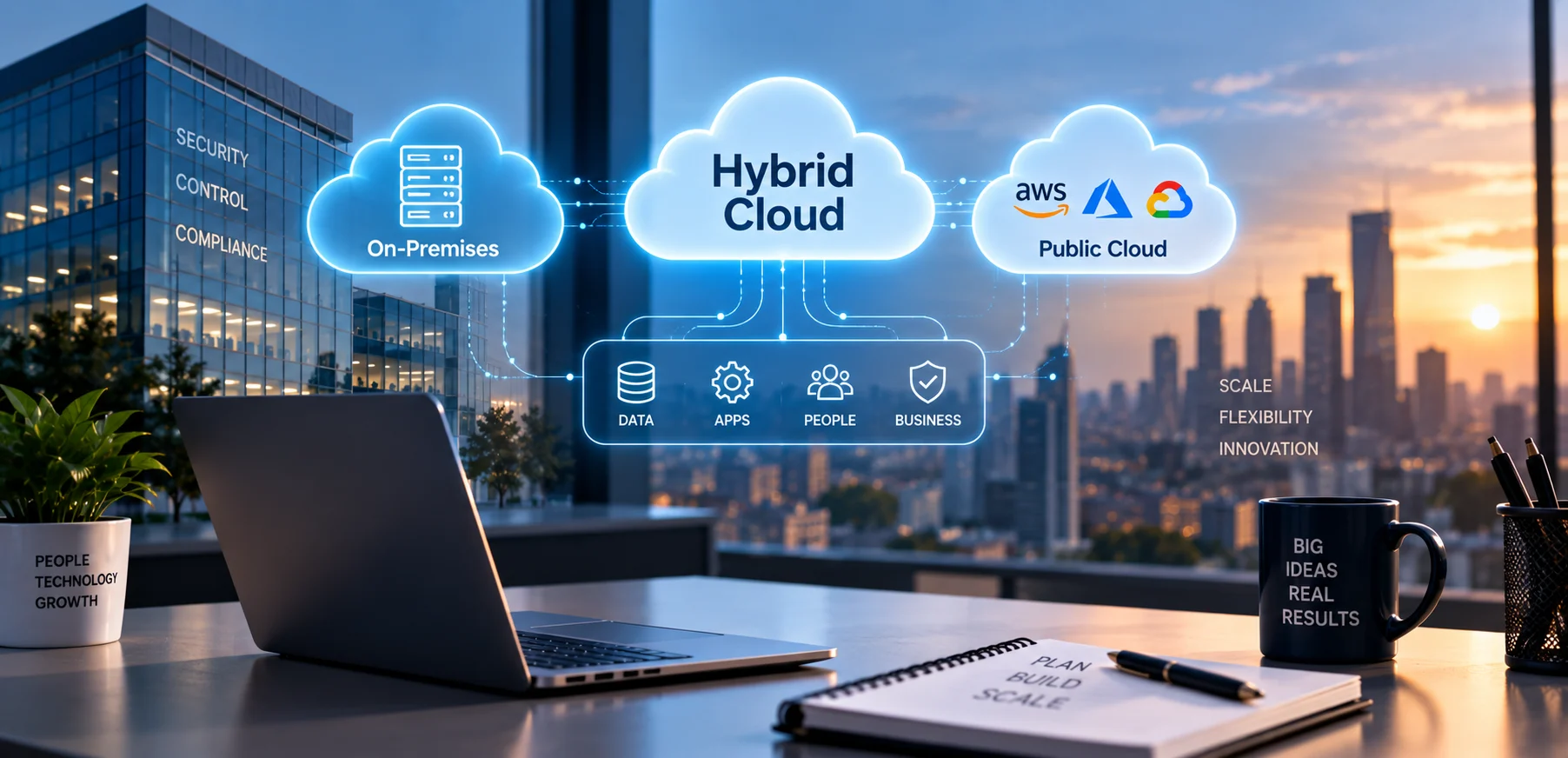
A hybrid cloud combines on-premises infrastructure (or a private cloud) with one or more public cloud providers like AWS, Microsoft Azure, or Google Cloud — all orchestrated to work as a single, unified environment. The key word here is orchestration: data and applications move seamlessly between environments based on cost, security, and performance needs.
Top Benefits Driving Adoption
- Flexibility: Run sensitive workloads on-prem, burst public when demand spikes.
- Cost optimization: Pay-as-you-go for variable workloads, reserved capacity for steady ones.
- Compliance: Keep regulated data in private environments while still benefiting from cloud agility.
- Disaster recovery: Built-in geographic redundancy without owning two data centers.
- Vendor independence: No lock-in to a single cloud provider.
Common Adoption Challenges
Hybrid is not without friction. Network latency between on-prem and cloud, identity management across environments, and data governance are the three issues we see most often. Most failed hybrid projects come from underestimating these.
The good news: each of these has mature, well-understood solutions today. Site-to-site VPN or AWS Direct Connect handles latency. Federated identity (Azure AD, Okta) handles authentication. And a unified data classification policy handles governance.
Hybrid cloud isn't about choosing between on-prem and cloud — it's about choosing the right tool for each workload.
How to Start Your Hybrid Journey
- Audit your existing workloads and classify them by sensitivity and elasticity.
- Pick one non-critical workload as your pilot — a dev environment is ideal.
- Establish secure connectivity and federated identity first.
- Build a cost monitoring dashboard before going live.
- Train your team continuously — hybrid skills are a moving target.
Conclusion
Hybrid cloud is the pragmatic path for most enterprises in 2026. It avoids the all-or-nothing trade-offs of fully on-prem or fully public-cloud strategies, and it future-proofs your infrastructure as business needs evolve. If you're still on the fence, connect with our cloud architects — we offer a free hybrid readiness assessment for your environment.
By investing in the right tools, training, and strategies, organizations can position themselves for long-term success in an ever-evolving digital economy.
Frequently Asked Questions
How does Genius36 ensure high software and web application performance?
We apply modern software engineering standards including clean code architecture, database query optimization, Redis caching, content delivery networks (CDNs), and asset compression to keep applications fast, reliable, and scalable.
How do I request a custom technical proposal?
Click the "Request Proposal" button above or call us at +91 82005 93901 . Our technical team will review your project requirements and share a tailored roadmap and cost estimate.
Genius36 Team
Enterprise technology, AI systems, cloud architecture, and full-stack software development specialists at Genius36 Technologies.