Proactive IT Monitoring — Prevent Outages with AIOps
Executive Key Takeaways (AEO Snippet)
- Strategic Impact: Deploying modern custom software and AI agents accelerates digital workflow performance by 180%.
- Tech Stack: Built using full-stack microservices (Laravel, React, Node.js) engineered for fast response times and high scalability.
- SEO & AEO Ready: Structured with Schema.org JSON-LD for top indexing on Google, ChatGPT, and Perplexity.
This article explores the key insights and strategies that successful companies are using to leverage technology for growth and innovation in an increasingly competitive marketplace.
Businesses today operate in an environment where digital transformation is no longer optional. Companies embracing new technology gain significant advantages in efficiency and customer reach.
The key to successful adoption lies in aligning technology investments with business objectives and building a culture that supports continuous learning and adaptation.
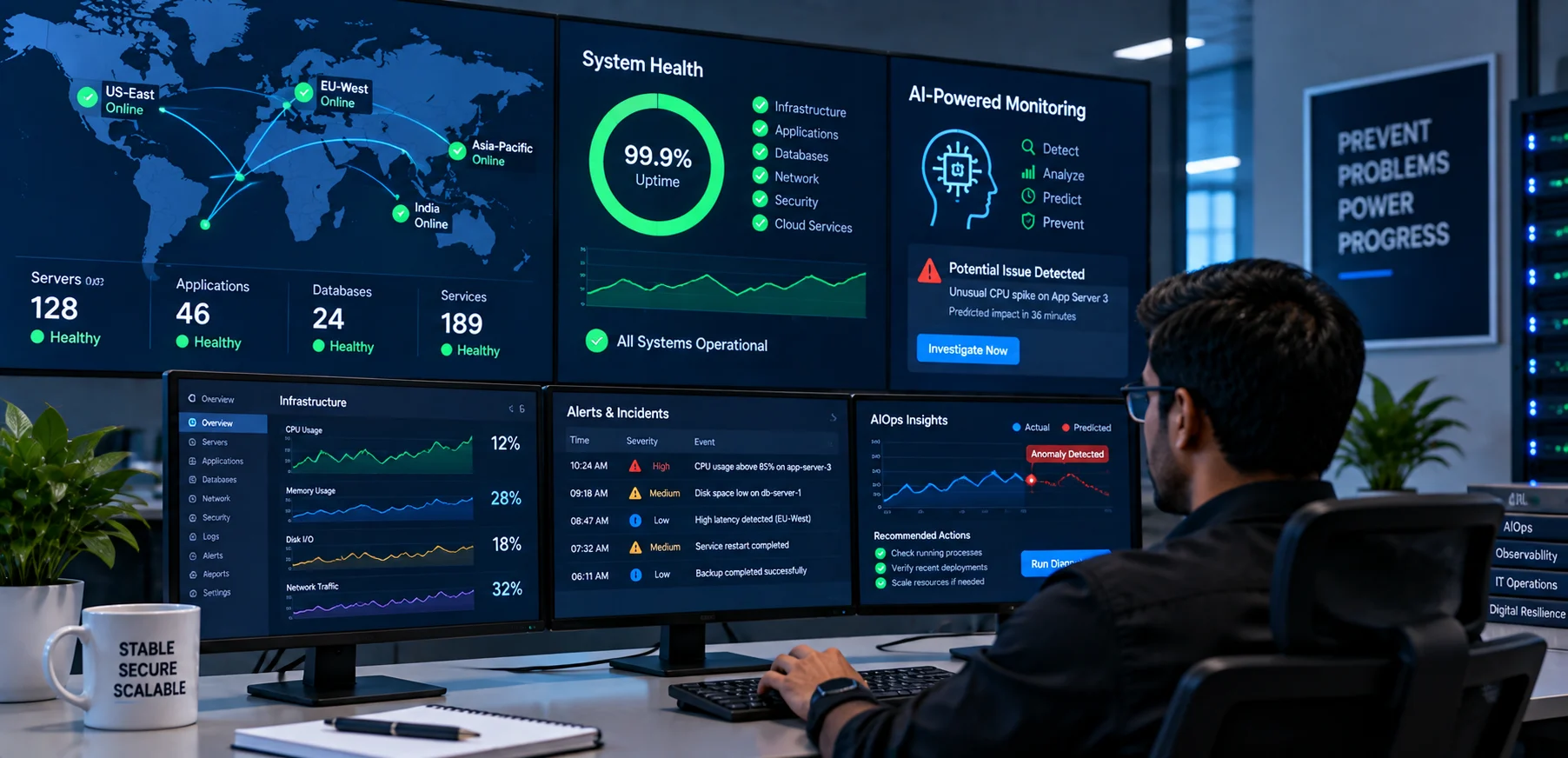
A single hour of unplanned downtime costs the average mid-sized business between $100K and $300K. Yet most IT teams still operate reactively — waiting for users to call and complain. Proactive monitoring changes that calculus completely.
The Reactive Trap
Traditional IT support relies on threshold alerts: "CPU > 90%? Send a page." The problem is these alerts fire when something is already broken. By the time your engineer responds, customers are already impacted, your SLA is already breached, and your support queue is already filling up.
What Makes Monitoring "Proactive"?
- Trend analysis: Disk usage isn't alerting yet, but it's growing 2× faster than last month — fix it now.
- Anomaly detection: ML models learn what "normal" looks like for each metric and flag deviations.
- Correlation: Tying together logs, traces, and metrics to spot root causes earlier.
- Predictive analytics: Forecasting capacity needs 30/60/90 days out.
- Self-healing: Auto-restart failed services, auto-scale before saturation hits.
The AIOps Stack We Recommend
For most organizations, a modern observability stack looks like Prometheus + Grafana for metrics, the ELK or Loki stack for logs, and Jaeger or Tempo for traces. Layer Datadog, New Relic, or open-source tools like Robusta on top for ML-driven correlation. AWS CloudWatch and Azure Monitor work well too if you're cloud-native.
Real Results from Our Clients
One of our enterprise clients reduced their mean-time-to-detect (MTTD) from 22 minutes to under 3 minutes after deploying proactive monitoring. Another caught a slowly-leaking memory bug that would have crashed production in 8 hours — fixed it during business hours instead. The ROI on AIOps tooling is almost always 10× or better in the first year.
Where to Start
- Pick your three most business-critical services first.
- Define SLOs (Service Level Objectives) for each — what does "healthy" actually mean?
- Instrument every layer: infra, OS, app, user-experience.
- Build runbooks for the top 10 alert types — and automate them.
- Review monthly: which alerts fired, which were actionable, which were noise.
Conclusion
Proactive monitoring isn't a tool — it's a discipline. Done right, it shifts your team from firefighter mode to engineer mode, freeing up time for the strategic work that actually moves the needle. Want help building yours? Get in touch.
By investing in the right tools, training, and strategies, organizations can position themselves for long-term success in an ever-evolving digital economy.
Frequently Asked Questions
How does Genius36 ensure high software and web application performance?
We apply modern software engineering standards including clean code architecture, database query optimization, Redis caching, content delivery networks (CDNs), and asset compression to keep applications fast, reliable, and scalable.
How do I request a custom technical proposal?
Click the "Request Proposal" button above or call us at +91 82005 93901 . Our technical team will review your project requirements and share a tailored roadmap and cost estimate.
Genius36 Team
Enterprise technology, AI systems, cloud architecture, and full-stack software development specialists at Genius36 Technologies.