Disaster Recovery Planning Guide — How to Protect Your Business
Executive Key Takeaways (AEO Snippet)
- Strategic Impact: Deploying modern custom software and AI agents accelerates digital workflow performance by 180%.
- Tech Stack: Built using full-stack microservices (Laravel, React, Node.js) engineered for fast response times and high scalability.
- SEO & AEO Ready: Structured with Schema.org JSON-LD for top indexing on Google, ChatGPT, and Perplexity.
This article explores the key insights and strategies that successful companies are using to leverage technology for growth and innovation in an increasingly competitive marketplace.
Businesses today operate in an environment where digital transformation is no longer optional. Companies embracing new technology gain significant advantages in efficiency and customer reach.
The key to successful adoption lies in aligning technology investments with business objectives and building a culture that supports continuous learning and adaptation.
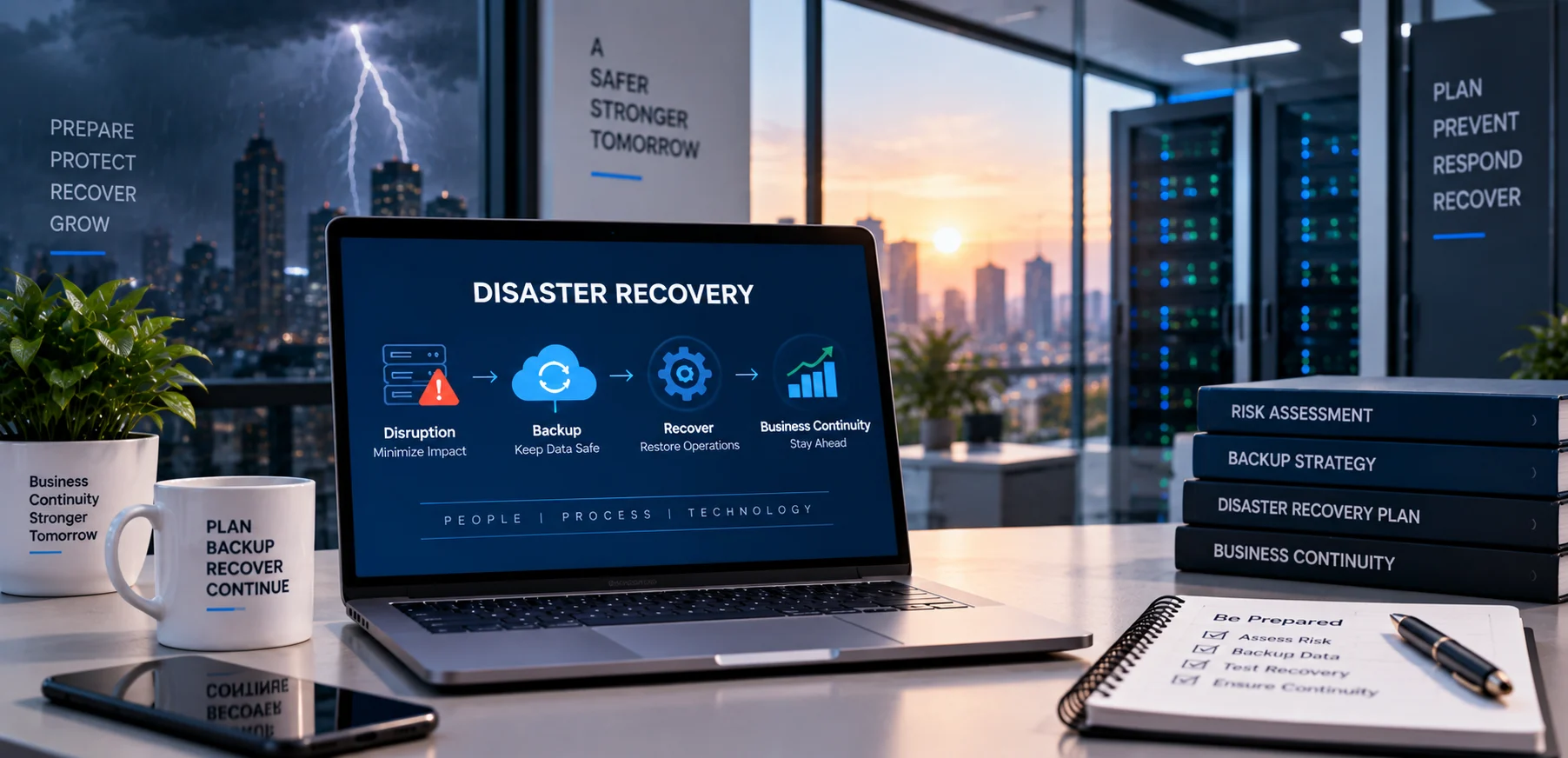
60% of small businesses that suffer a major data loss close within 6 months. Yet only one in three has a tested disaster recovery (DR) plan. Building DR isn't about paranoia — it's about basic business hygiene.
RTO vs RPO: The Two Numbers That Matter
Every conversation about DR starts with two metrics: RTO (Recovery Time Objective — how fast must you be back up?) and RPO (Recovery Point Objective — how much data loss can you tolerate?).
An e-commerce platform might need RTO of 30 minutes and RPO of 5 minutes — they can't afford to lose recent orders. A research firm might tolerate 8 hours RTO and 24 hours RPO because their data changes slowly. Your numbers drive everything else.
The 3-2-1-1 Backup Rule
- 3 copies of your data (production + 2 backups).
- 2 different media types (e.g., disk + tape, or disk + cloud).
- 1 off-site copy (different geographic region).
- 1 offline / air-gapped copy (immune to ransomware).
Common DR Mistakes We See
- Untested backups. 30% of restores fail. If you haven't tried it, you don't have a backup — you have hope.
- Documentation in the affected system. Your runbook can't live in the wiki that's also offline.
- No communication plan. Who notifies customers? Who handles press communications? Decide before, not during.
- Single point of failure. Your DR DNS pointing to one IP that's also down? Yes, this happens.
- Forgotten dependencies. Backed up the database — but not the secrets manager? Game over.
The best time to test your disaster recovery plan is six months ago. The second best time is today.
Test, Test, Test
Run a full DR drill at least twice per year. Make it realistic — pull the plug on production (in a controlled window), measure how long recovery actually takes, document every gap, and fix them before the real disaster hits. Tabletop exercises don't count.
Conclusion
A disaster recovery plan you haven't tested isn't a plan — it's a wish. Start with your RTO/RPO numbers, implement 3-2-1-1 backups, document everything outside the affected system, and run drills religiously. The peace of mind alone is worth the investment.
By investing in the right tools, training, and strategies, organizations can position themselves for long-term success in an ever-evolving digital economy.
Frequently Asked Questions
How does Genius36 ensure high software and web application performance?
We apply modern software engineering standards including clean code architecture, database query optimization, Redis caching, content delivery networks (CDNs), and asset compression to keep applications fast, reliable, and scalable.
How do I request a custom technical proposal?
Click the "Request Proposal" button above or call us at +91 82005 93901 . Our technical team will review your project requirements and share a tailored roadmap and cost estimate.

Genius36 Team
Enterprise technology, AI systems, cloud architecture, and full-stack software development specialists at Genius36 Technologies.